What your body can do today, and what to work on for the years ahead. Four movements, under fifteen minutes.
See what's in the report ↓
Power is your ability to generate speed against a force.
"Strength means you can lift a suitcase. Power means you can hoist it into the overhead bin."
"Power is what lets you stand up quickly, climb stairs, and catch yourself before you fall. Power fades earlier than strength, and you'll feel it more."
From the Power & Longevity Report
According to a 10-year Mayo Clinic study of nearly 4,000 adults, those with the lowest muscle power were six times more likely to die than those with the highest.
Mayo Clinic Proceedings, August 2025. An observational study: it found an association, and it did not test whether a Proteus assessment or an eight-week program extends life.
A personalized look at your power, your trajectory, and what to do about it.
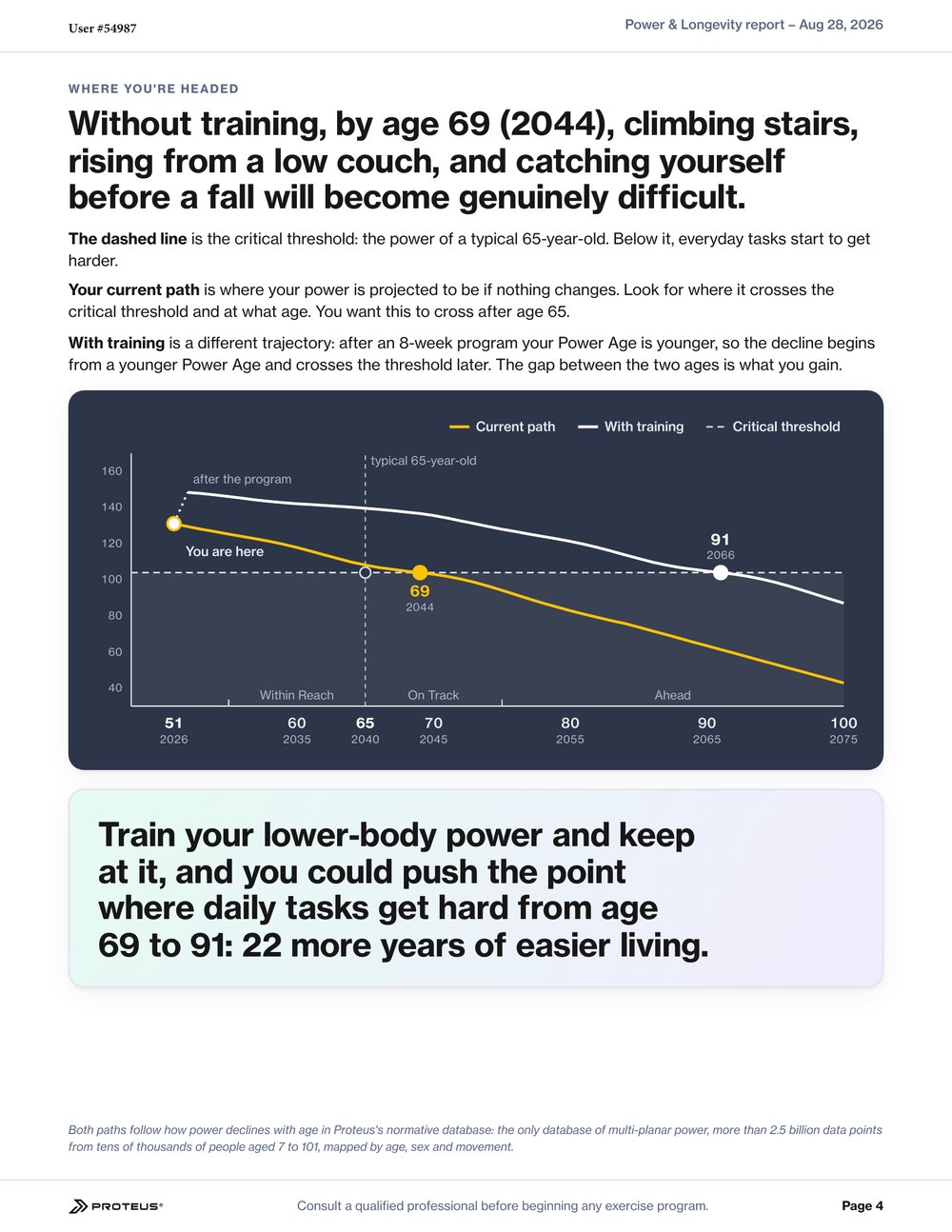
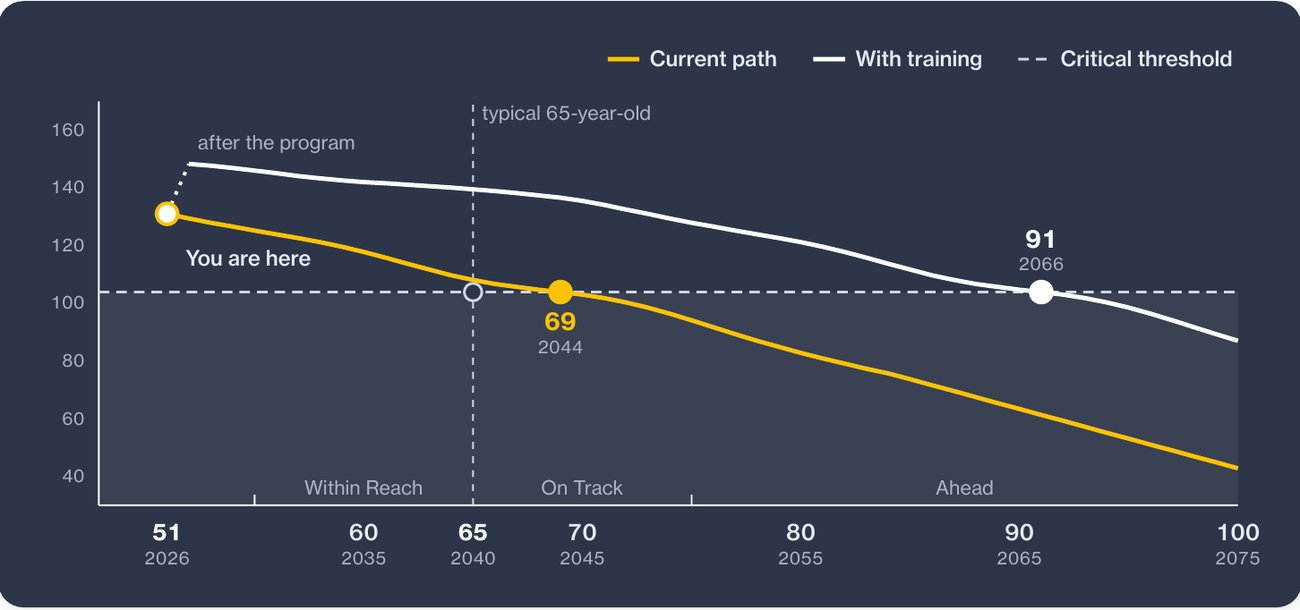
The dashed line is the critical threshold: the power of a typical 65-year-old. Below it, everyday tasks start to get harder. Look for where your path crosses it, and at what age.

Where your power is projected to be if nothing changes. You want this to cross after age 65.
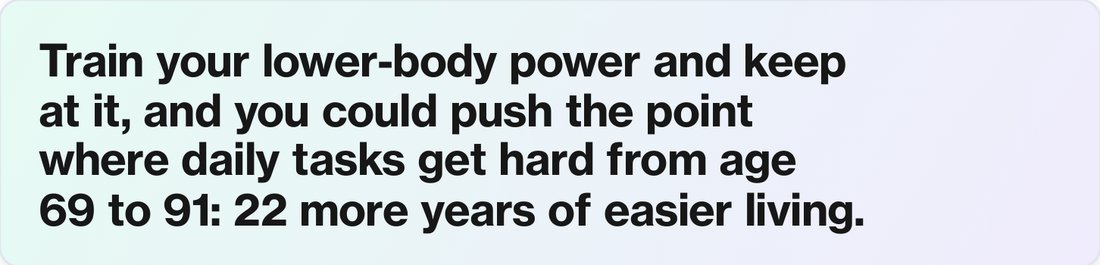
After an 8-week program your Power Age is younger, so the decline begins from a younger Power Age and crosses the threshold later.
The power of a typical 65-year-old. The gap between the two crossing ages is what you gain.

Both paths follow how power declines with age in Proteus's database, mapped by age, sex and movement, and the critical threshold is the power of a typical 65-year-old in that data. They are modeled trajectories, not a prediction of how long you will live.
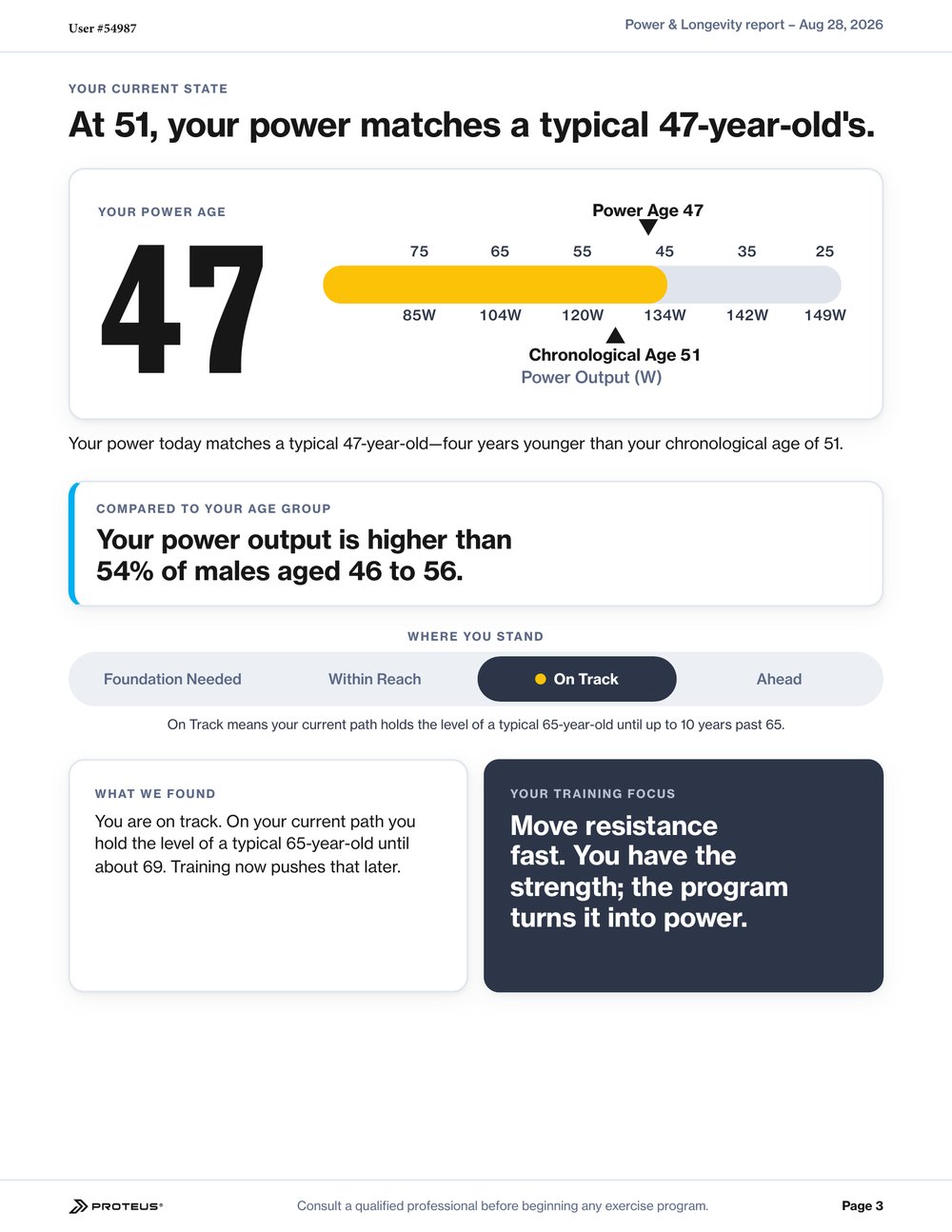
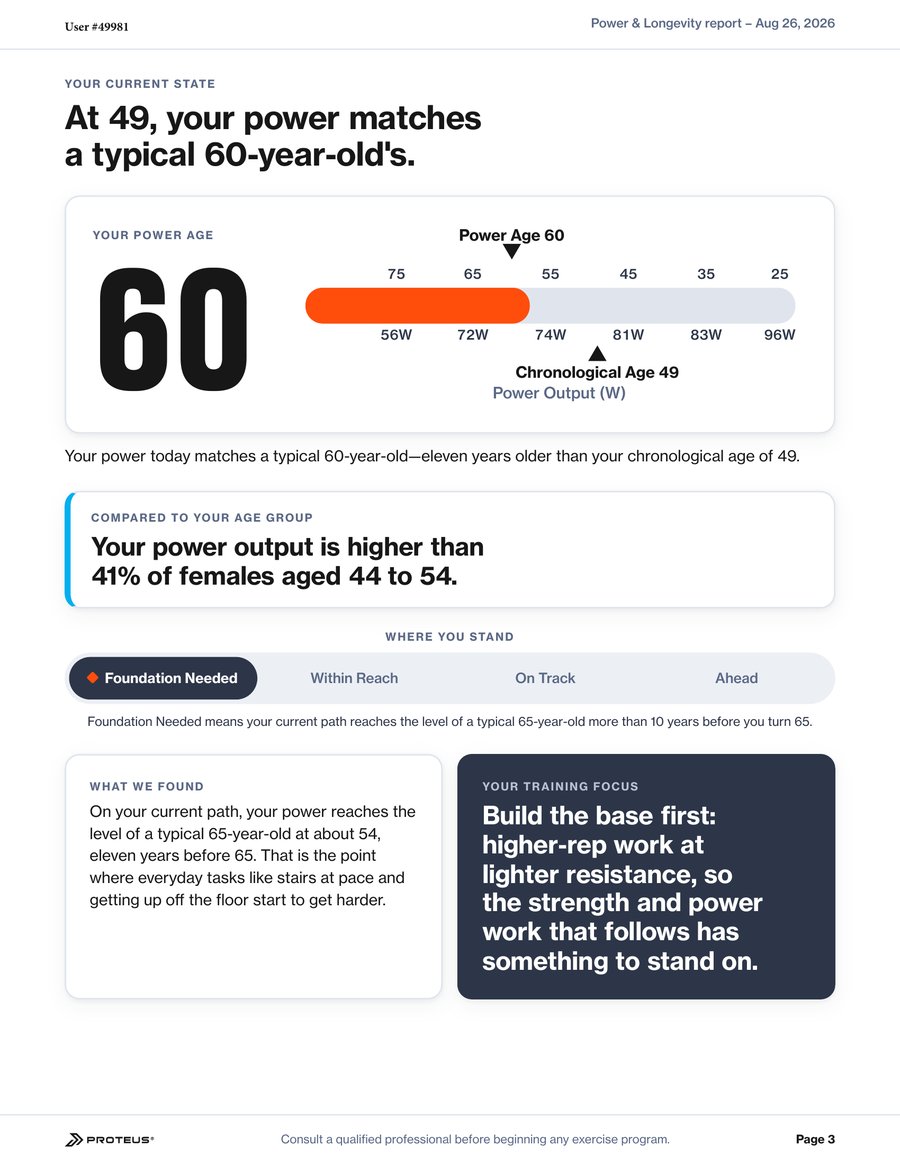
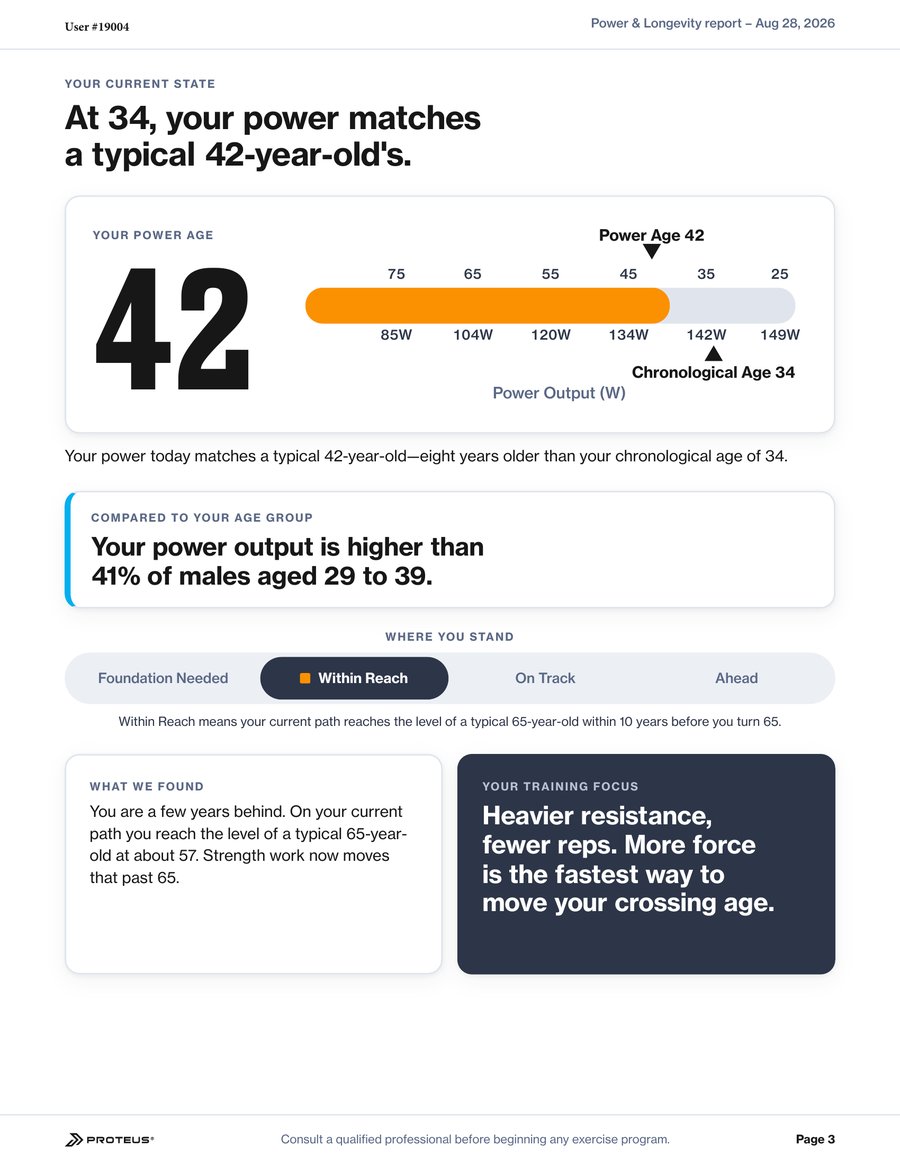
The report places you by where your current path crosses the power of a typical 65-year-old. Four real, anonymized samples.
"On your current path, your power reaches the level of a typical 65-year-old at about 54, eleven years before 65. That is the point where everyday tasks like stairs at pace and getting up off the floor start to get harder."
"Build the base first: higher-rep work at lighter resistance, so the strength and power work that follows has something to stand on."
"You are a few years behind. On your current path you reach the level of a typical 65-year-old at about 57. Strength work now moves that past 65."
"Heavier resistance, fewer reps. More force is the fastest way to move your crossing age."
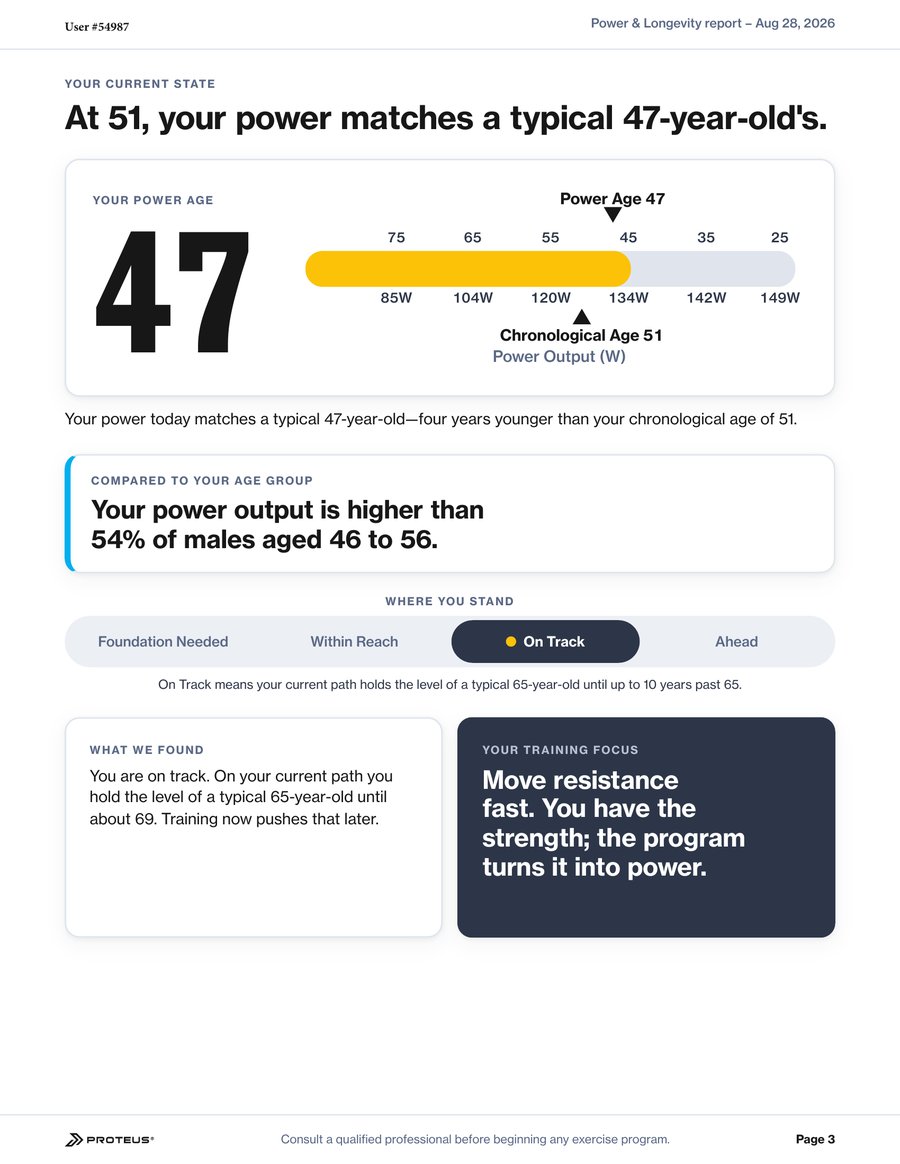
"You are on track. On your current path you hold the level of a typical 65-year-old until about 69. Training now pushes that later."
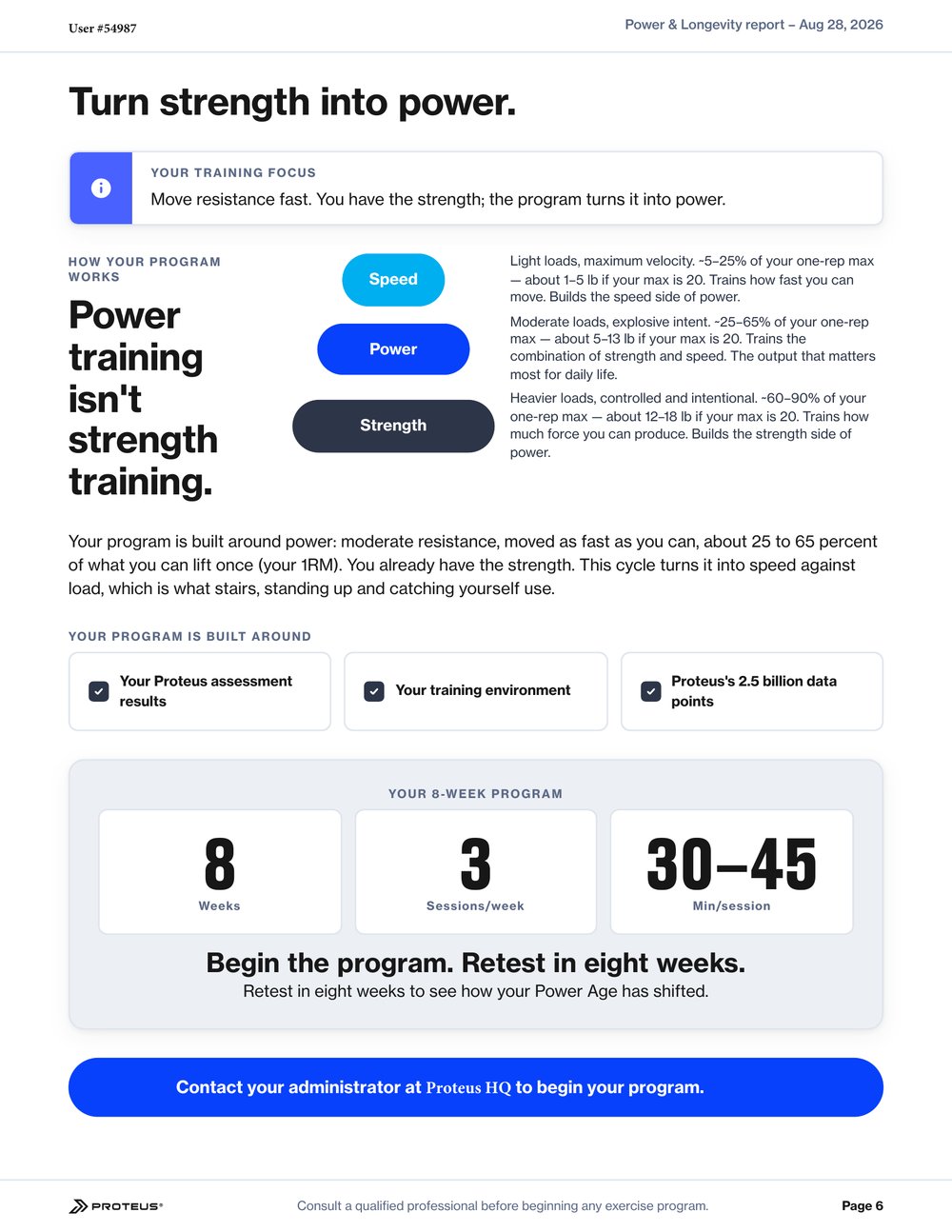
"Move resistance fast. You have the strength; the program turns it into power."
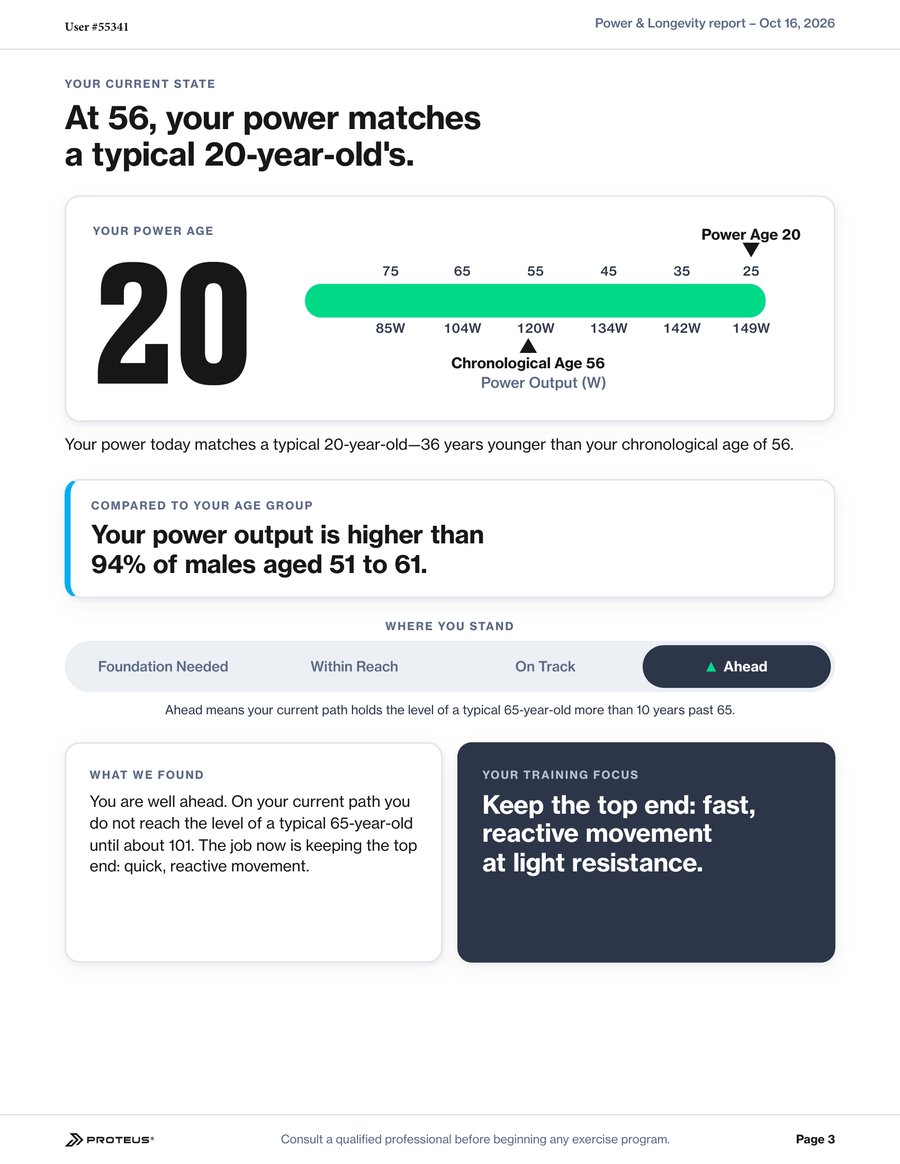
"You are well ahead. On your current path you do not reach the level of a typical 65-year-old until about 101. The job now is keeping the top end: quick, reactive movement."
"Keep the top end: fast, reactive movement at light resistance."
If you are 65 or over, your result is set by the gap between your Power Age and your age instead: more than 15 years older, up to 15 years older, up to 15 years younger, or more than 15 years younger.
Your results are compared against more than 2.5 billion data points from tens of thousands of people, ages 7 to 101, factored by age, sex, and movement type.
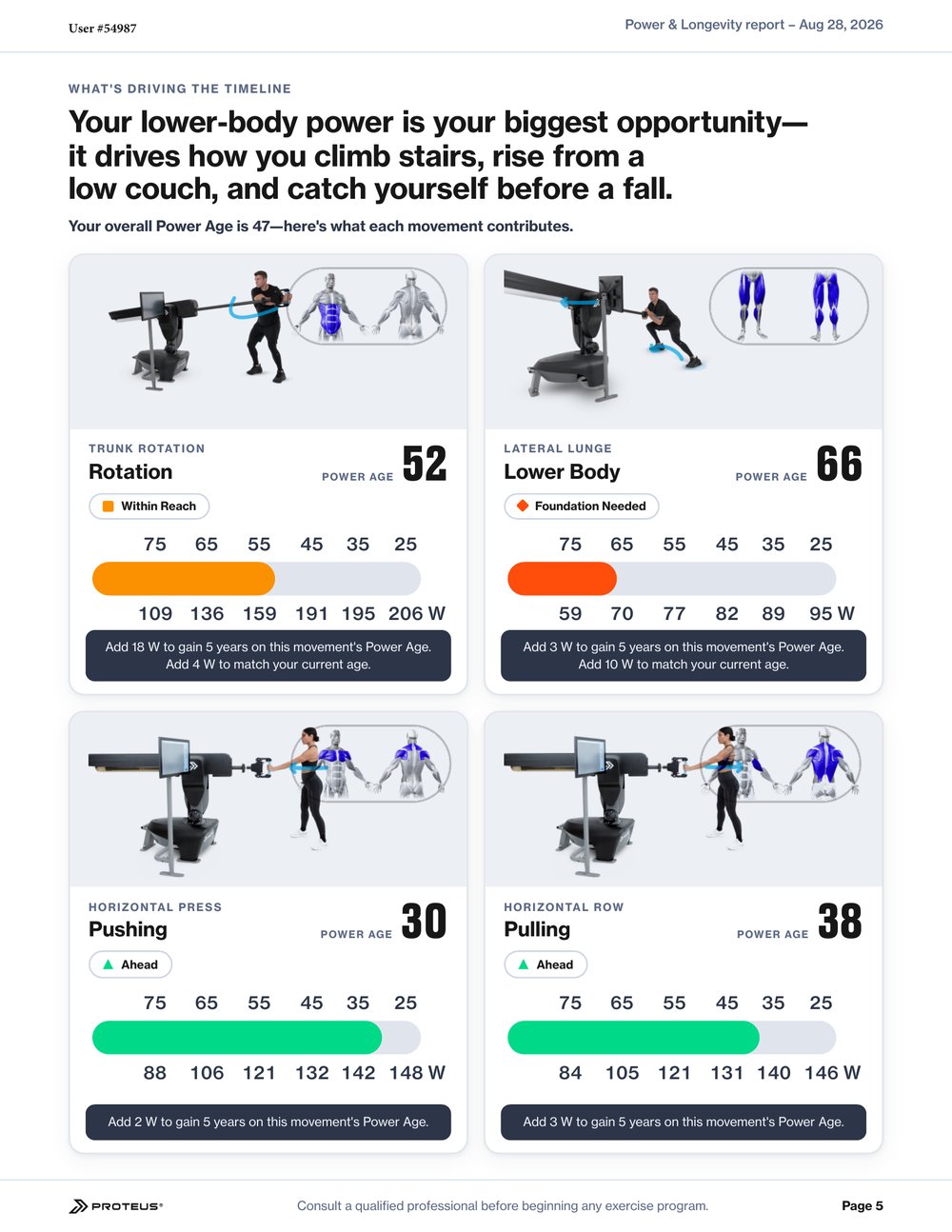
Proteus holds resistance steady in every direction while you move, and measures how fast you move it. These are the movements behind your report.

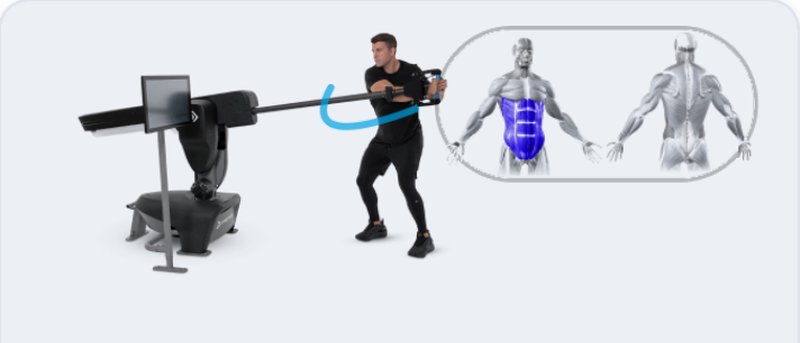
Checking your blind spot. Reaching across your body. Getting in and out of a car.

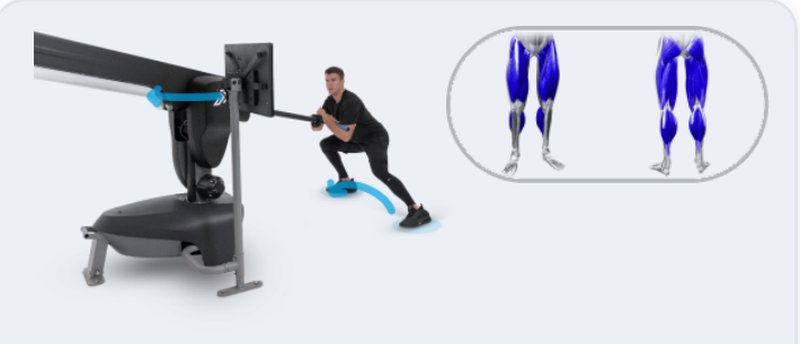
Climbing stairs. Rising from a low couch. Catching yourself before a fall.

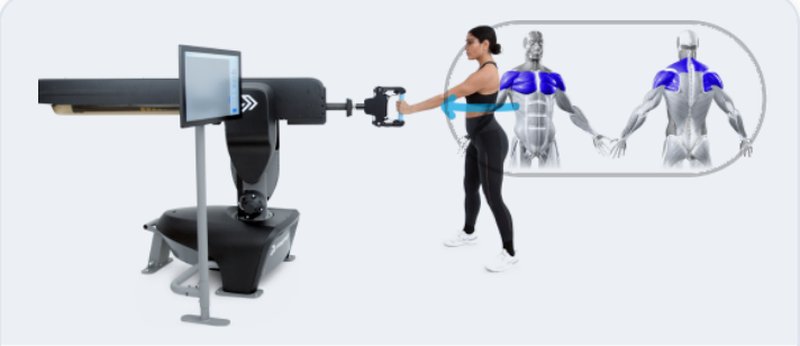
Press out with one hand, then row back. Both sides.

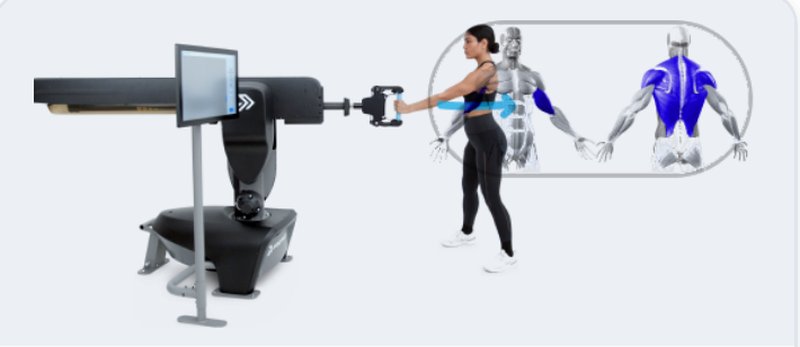
The return half of the same rep. Scored on its own.
The lateral lunge can be skipped if needed; the report still generates.
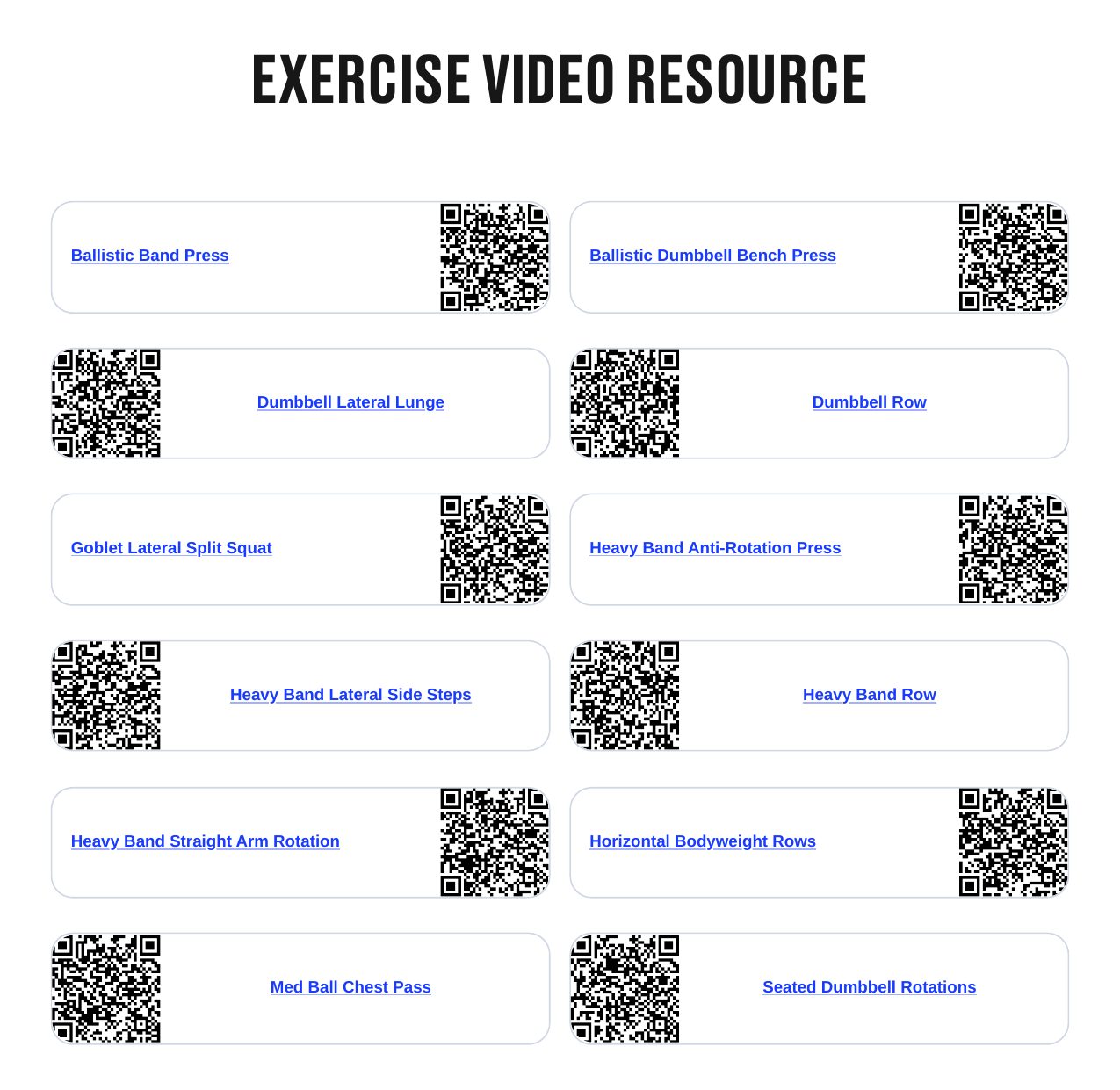
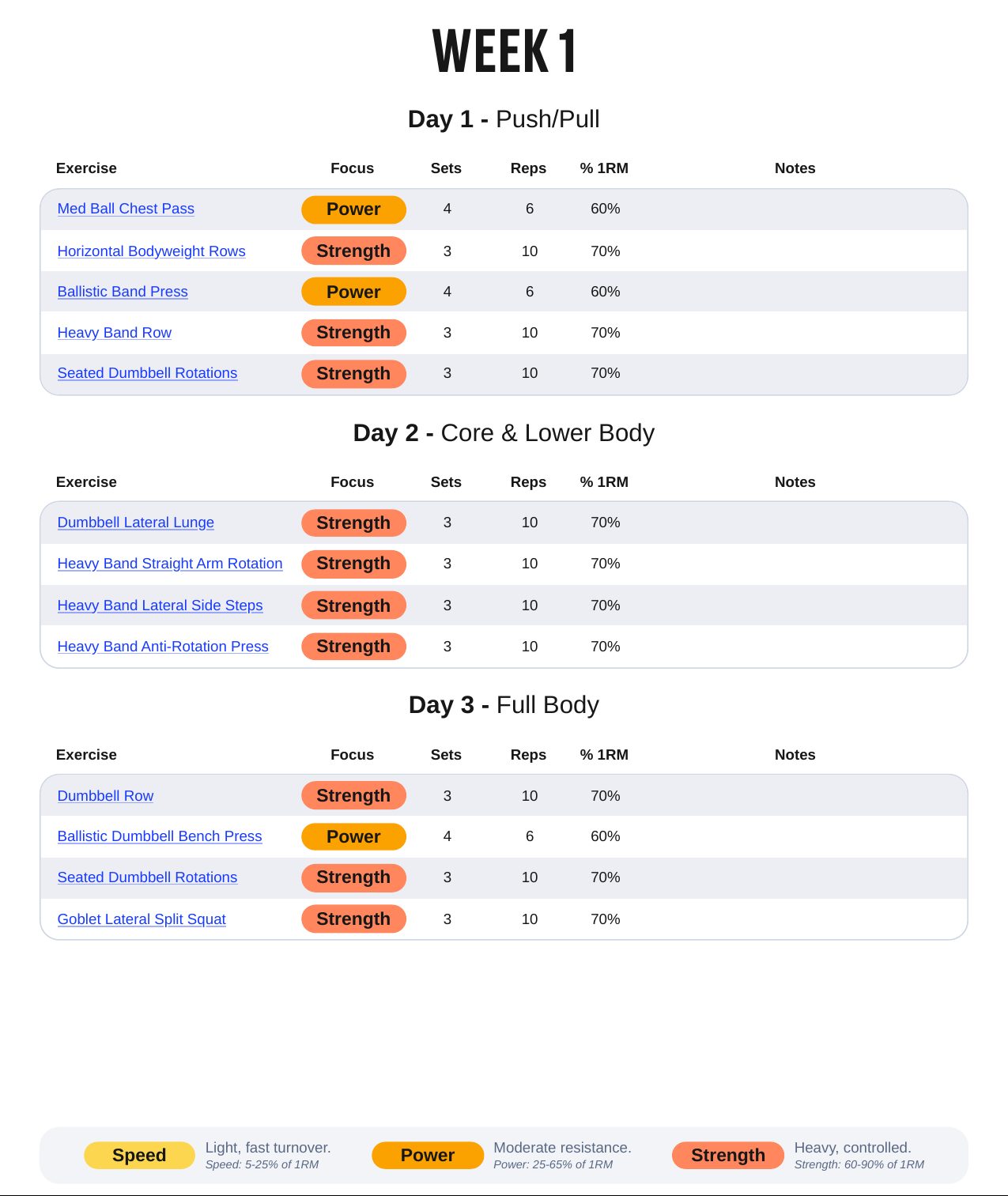
Your report sets your training focus: build the base, get stronger, turn strength into power, or keep the top end. Your program is built from your results, movement by movement, and comes to you by email as a PDF with a video for every exercise.


"Begin the program. Retest in eight weeks."
Your program is available through your Proteus location.
A DEXA scan measures capacity: how much lean mass you have, your bone density, your body fat. Proteus measures capability: the power that muscle produces when you move. One shows what's there; the other shows whether it works. You don't need a DEXA scan to get the Power & Longevity Report, and many locations run both in the same visit.
Lean mass, body fat, bone density, visceral fat.
Power in watts across four movements, your Power Age, where it's headed, and the training focus that moves it.
Researchers at the University of the Pacific measured people on both and found two things. When two people have the same amount of muscle, the older one does not produce less power. And people who produce more power have denser bones, beyond what their muscle alone would predict.
Eight abstracts from the University of the Pacific with Proteus, published in Medicine & Science in Sports & Exercise (American College of Sports Medicine), September 2026. Every participant was measured on Proteus and on DEXA in the same session. The work is cross-sectional, in adults roughly 25 to 65, so it describes how power, muscle and bone relate across people; it does not show that training one changes the others.
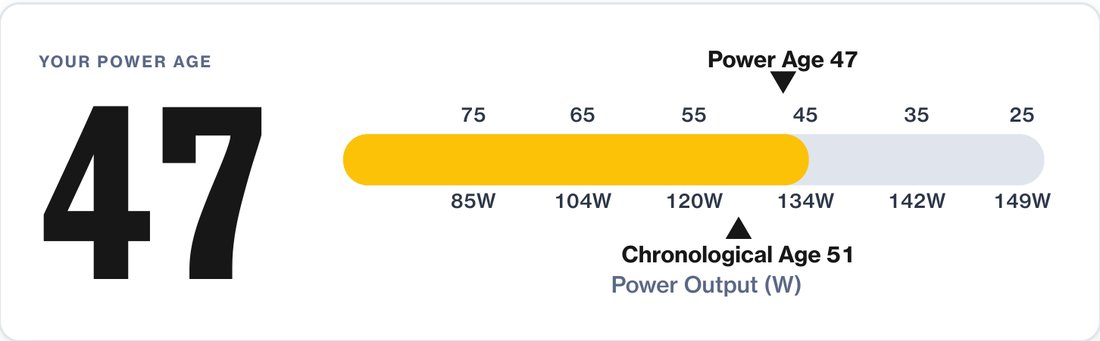
"Your Power Age is the age whose typical power output is closest to yours." The report finds it separately for each of the four movements and averages them for the overall number. It is a power comparison, not your biological age.
No. It compares your power with the Proteus database and shows modeled power trajectories. Those projections do not say when you will lose independence or how long you will live.
It can be skipped. The report still generates, and your Power Age averages the movements you completed.
No. The report stands on its own. If your location also offers DEXA, the two run in the same visit.
No. Your results are compared with Proteus's database, matched to your age, sex and movement. Where you tested has no effect on your result.
Because the comparison data is built at 10 pounds: everyone in the database did the same four movements at the same resistance. Power is strength times speed, so a stronger person moves the same resistance faster rather than running out of room.
After the eight-week program, to see how your Power Age has shifted.
Sources: Proteus Power & Longevity sample reports, pages 2 to 7. Mayo Clinic, "The Need for Speed: Improving Muscle Power for Longevity," Mayo Clinic Proceedings, August 2025. University of the Pacific, abstracts in Medicine & Science in Sports & Exercise, September 2026. Consult a qualified professional before beginning any exercise program.